

Preliminary Reports
PHOENIX-UASL
➤ Preliminary Reports
First year
I report I-IV months (Reporting Period: September–December 2025)
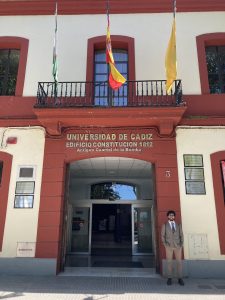
Antonio Pecci at the Department of History, Geography and Philosophy, University of Cádiz (photo by Ida Campanile)
Project management, coordination and integration
During the first four months of the action, Antonio Pecci successfully completed all administrative, institutional, and logistical procedures required for full integration into the Universidad de Cádiz. These included personal administrative formalities and access to university services, research facilities, and academic structures.
Project planning and coordination activities were initiated and continuously developed in close collaboration with the supervisor. Regular meetings and ongoing bidirectional communication with the Phoenix Mediterranea team, the excavation staff, and the research mission ensured effective alignment between project objectives, methodologies, and planned activities. This phase focused on establishing a solid organizational and scientific framework for the action.
Research and fieldwork activities
Research activities commenced with extensive bibliographic research relevant to Phoenician–Punic archaeology, fortification systems, and the application of unmanned aerial systems in archaeological contexts. Part of this research was conducted during a short research period in Italy.
Antonio Pecci actively participated in archaeological fieldwork at the Doña Blanca site, contributing to excavation activities, geophysical surveys, and drone-based photogrammetric documentation of the excavation area, with particular emphasis on the northern fortification walls. These activities directly supported the research objectives of the project.
Dedicated coordination meetings were held with the Servicio de Drones of the University of Cádiz to plan, schedule, and program drone flight operations, laying the groundwork for the integration of advanced remote sensing techniques into the project.
In addition, focused scientific discussions were conducted with David Montanero Vico (Institut Català d’Arqueologia Clàssica) on Phoenician fortification theory and practice, contributing to the conceptual and interpretative framework of the research.
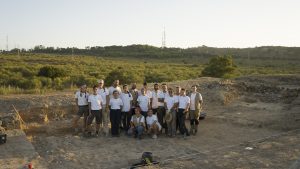 The UCA team engaged in the 2025 excavation campaign at the Doña Blanca site (photo by Pablo Sicre González) |
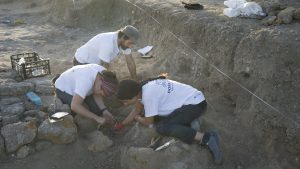 Image from the excavation of the archaeological site of Doña Blanca (photo by Pablo Sicre González |
Training and skills development
During the reporting period, Antonio Pecci attended a Spanish language course (B1 level) at the UCA Language Center, successfully passing the final examination. This training supported effective communication, institutional integration, and participation in field and academic activities.
Complementary training activities included the completion of a 16-hour online course on artificial intelligence tools and prompt strategies for research, enhancing methodological and digital research skills relevant to data analysis and innovation within the project.
Professional development was further strengthened through participation in the International Workshop “United by the Atlantic: Identifying Synergies for the Study of Archaeological Heritage” (University of Cádiz, November 2025), where Antonio Pecci delivered an oral presentation entitled “PHOENIX-UASL: Research on Phoenician–Punic Sites in Andalusia Using an Experimental Unmanned Aerial System with LiDAR”.
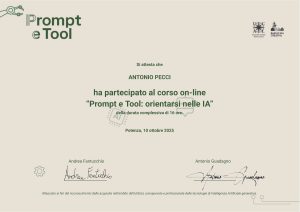 Certification of course on artificial intelligence tools and prompt |
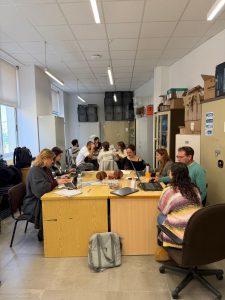 Image from International Workshop “United by the Atlantic: Identifying Synergies for the Study of Archaeological Heritage” (University of Cádiz, 28 November 2025) |
Communication, dissemination and exploitation
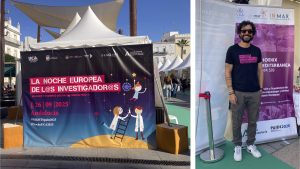
Images from the European Researchers’ Night (San Fernando, Spain, September 2025)
Significant efforts were dedicated to communication and dissemination activities. Antonio Pecci developed advanced digital skills through training in WordPress and created the official project website (Phoenix UASL), providing an online platform for project visibility and public communication. Official project social media accounts were also established on Instagram, X, and Facebook.
Public engagement activities included active participation in multiple events during La Noche Europea de los Investigadores, involving workshops, educational activities, and open days related to Phoenician archaeology and the Doña Blanca site.
Further dissemination actions comprised a newspaper interview published in La Voz del Sur, and a radio interview broadcast on Canal SUR Radio (“Andalucía Ahora”), contributing to increased visibility of the project and its innovative methodological approach.
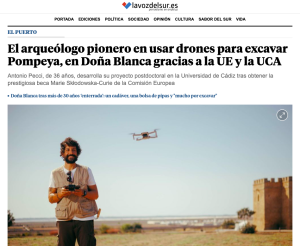 Screen from press interview published in La Voz del Sur |
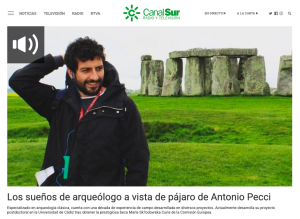 Screen from the webpage of radio interview broadcast on Canal SUR Radio, programme “Andalucía Ahora” |
Summary of progress
Overall, the first four months of the action were dedicated to project setup, training, initial research and fieldwork, and the establishment of a strong dissemination and communication strategy. All planned activities for the reporting period were successfully implemented, and the project is fully on track with respect to its objectives, work plan, and training goals.