

ABOUT THE PROJECT
PHOENIX-UASL
Project Overview

PHOENIX-UASL – Research on PHOENIcian-punic sites in Andalusia with eXperimental Unmanned Aerial System with LiDAR is a research project funded by the Marie Skłodowska-Curie Postdoctoral Fellowship (MSCA-PF) programme of the European Union (PHOENIX-UASL, Grant agreement ID: 101155484).
The project explores the potential of UAS-LiDAR technology (LiDAR mounted on drones) for archaeological landscape analysis and for reconstructing the long-term history of ancient settlements in western Andalusia (Spain).
PHOENIX-UASL aims to evaluate the capabilities, limits, and methodological value of these emerging systems, contributing to the development of operational protocols and best practices, which are currently missing in the field.
Scientific Background
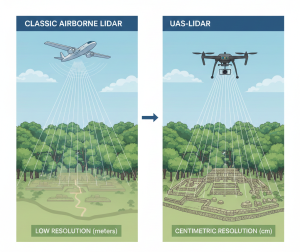
Workflow (image created using AI, prompt by A. Pecci, using Gemini)
Remote sensing techniques, especially UAS equipped with advanced sensors (RGB, thermal, multispectral, LiDAR), have become essential tools in modern archaeology.
LiDAR from aircraft was historically limited by high costs and low resolution, but recent advances allow centimetric-resolution data acquired at low cost, enabling the detection of microtopography otherwise invisible beneath vegetation or modern alterations.
However:
-
application guidelines
-
comparative studies
-
methodological standards
are still lacking.
PHOENIX-UASL fills this gap.
Case Studies

Case study area (edited by A. Pecci)
The research focuses on specific case studies previously examined in preliminary analyses, including Phoenician-Punic fortified settlements such as the Castillo de Doña Blanca (El Puerto de Santa María), as well as indigenous sites in the Bay of Cádiz, combining technological advances and traditional methods to develop a standardized application protocol for drone-based archaeology.
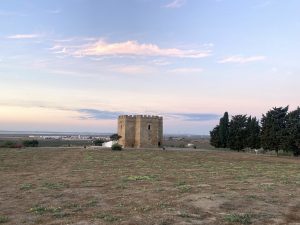
Castillo de Doña Blanca (El Puerto de Santa María) (photos by A. Pecci)
Main Objectives
MO1 – Methodological innovation
To test, compare and evaluate UAS-LiDAR technologies for archaeological survey, defining:
-
acquisition methods
-
flight plans and scanning parameters
-
processing workflows
-
interpretative strategies
MO2 – Historical-topographical reconstruction
To analyse the diachronic development of the studied sites from Prehistory to the early Middle Ages, integrating:
-
field surveys
-
GIS analysis
-
archaeological, environmental and historical data
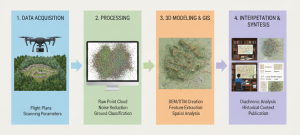
Workflow (image created using AI, prompt by A. Pecci, using Gemini)
THE RESEARCHER – PhD. Antonio Pecci
PhD. Antonio Pecci is a Marie Skłodowska-Curie Postdoctoral Fellow and the Principal Researcher of the PHOENIX-UASL project.
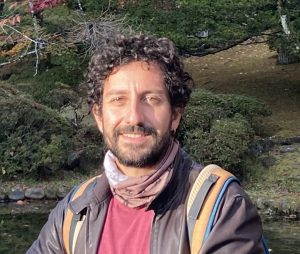
Short bio: Antonio Pecci is a PhD in archaeology and an archaeologist specializing in classical archaeology. He has a decade of field experience carried out in various archaeological projects, at universities and private committees. He is currently excavation director of the archaeological missions of the University of Basilicata (scientific dir. M. C. Monaco) in Ferrandina (Matera, Italy) (“FArch – Ferrandina Archeologica”) and deputy excavation director in Metaponto (“Abitare a Metaponto”). For several years he has worked and collaborated with the National Research Council (CNR) on numerous archaeological study projects and has taken part in international missions in Peru (Pachacamac, Nasca, Cusco), Colombia (Cartagena de las Indias) and Argentina (Iguazu) and in Italy (Pompeii, Rome, Puglia and Basilicata), mainly focused on remote sensing analyses (mainly from drone). He is the author of numerous scientific articles in national and international journals and has participated as a speaker at several scholarly conferences. In addition to having given several university seminars, he has been a lecturer in masters and schools on the use of drones and new technologies applied to cultural heritage in Italy and abroad. Furthermore, he is the author of the first and unique manual on the use of drones in archaeology “Introduzione all’utilizzo dei droni in archeologia”. He is also the author of the monographic volume on the ancient fortifications of Basilicata “Fortificazioni e sistemi di difesa tra IV e III sec. a.C. in Basilicata”, Lagonegro 2025. His main research interests, in addition to remote sensing, aerial archaeology and drones in archaeology, include landscape archaeology, archaeological research methodology, ancient topography, archaeology of ancient Basilicata, cultural heritage enhancement and communication, and public archaeology.
Currently, he is a MSCA PF researcher at Universidad de Cádiz (Departamento de Historia, Geografía y Filosofía).


Host Institution
The project takes place at the University of Cádiz (UCA), within the research group:

HUM509 – PHOENIX MEDITERRANEA
Department of History, Geography and Philosophy
Directed by: Prof. Ana María de Niveau de Villedary y Mariñas
Workflow (image created using AI, prompt by A. Pecci, using Gemini)
The Supervisor – Prof. Ana María de Niveau de Villedary y Mariñas
Prof. Ana María de Niveau de Villedary y Mariñas is the supervisor of the PHOENIX-UASL project.

Short bio: Her research career has been defined by a continuous pursuit of internationalization and excellence, demonstrated through the competitive grants she has obtained and recognized with the Research Excellence Award (UCA, 2019). She holds the I3 certification, which acknowledges both high-quality standards and an outstanding research trajectory, as well as four uninterrupted research assessment periods (sexenios, 1997–2020) and the five regional research evaluations (JA). She has completed pre- and postdoctoral research stays in Italy (2000, 2002–04, 2018), Portugal (1997), France (2006), and the United Kingdom (1998, 2015, 2017–Madariaga, University of Oxford), which have enabled her to establish strong and lasting relationships with research teams outside Spain, participate in numerous projects, excavations, publications, and scientific meetings, and integrate meaningfully into these international academic and scientific networks.
The recognition of her trajectory and expertise is further demonstrated by her participation in expert panels for official institutions (AEI, Spain; REPRISE/MIUR, Italy; European Science Foundation, EU) and by her extensive and regular evaluation activity for prestigious Spanish and international scientific journals and publishers (FR, PT, GB, USA, IT, BE), as well as for research grants and project proposals.
Her main scientific achievements stem from her doctoral thesis (defended in 2001; published in 2003), focused on the so-called “Kuass-type” ceramics, which represented a major advance in the understanding of the final pre-Roman phases in the Far West. Her work resulted in the systematization of a new ceramic production and the full acceptance of her conclusions by the scientific community, replacing previous typologies and becoming a widely used scientific reference. Alongside this, she has developed additional research lines: (1) historiographical and revisionist approaches; (2) the incorporation of new theoretical–methodological perspectives and multidisciplinary analyses into the study of Phoenician–Punic funerary ritual in the Far West; and (3) the analysis of settlement patterns and territorial occupation strategies during Protohistory in the Bay of Cádiz and the southwestern Iberian Peninsula.
Since 2015, she has been the Principal Investigator of the research group HUM-509 (PAIDI/JA, UCA). She has led, as PI, a PGI funded by the Regional Government of Andalusia (on the Phoenician–Punic necropolis of Cádiz), a Proyecto Puente of UCA’s internal program (2018), two National Plan research projects (2019–2022; 2023–2027) with associated predoctoral contracts (the latest funded by UCA’s internal program), and a Proof of Concept project (2023–2024, call 2022). She supervises two postdoctoral contracts: a European MSCA-EC-2023-PF-01 Fellowship and a three-year postdoctoral contract funded by UCA’s internal program. In recent years, she has directed a substantial number of archaeological activities involving the study of materials from funerary, ritual, productive, and domestic contexts in the city of Cádiz, particularly the launch of a new program of actions at the Castillo de Doña Blanca. This work has allowed her to consolidate a stable team that includes the archaeologists responsible for fieldwork and a group of UCA master’s and doctoral students.
She has supervised three doctoral dissertations and has been responsible for two graduate contracts under Chapter VI. She has participated as a researcher in two European projects. In recent years, she has been actively involved in outreach, dissemination, and knowledge-transfer activities: lectures, participation in radio and television programs, publications in specialized outreach journals, exhibition organization, school outreach, OTRI contract direction, and scientific tours and tastings. She represents UCA in the International Network of Universities of the Council of Europe’s Cultural Route “Phoenicians’ Route.”


Funding Acknowledgement

This project has received funding from the European Union’s Horizon Europe – Marie Skłodowska-Curie Postdoctoral Fellowship programme.
PHOENIX-UASL Grant agreement ID: 101155484
EC signature date, 16 May 2024
Start date, 1 September 2025
End date, 31 August 2027
Funded under Marie Skłodowska-Curie Actions (MSCA)
EU contribution € 181.152,96
https://cordis.europa.eu/project/id/101155484
Credits
Logo design by Pablo Sicre González — sincere thanks for his creative contribution to the project.